
Understanding TVOCs and Persistent Indoor Odors
What Smell Can—and Cannot—Tell You About Indoor Air
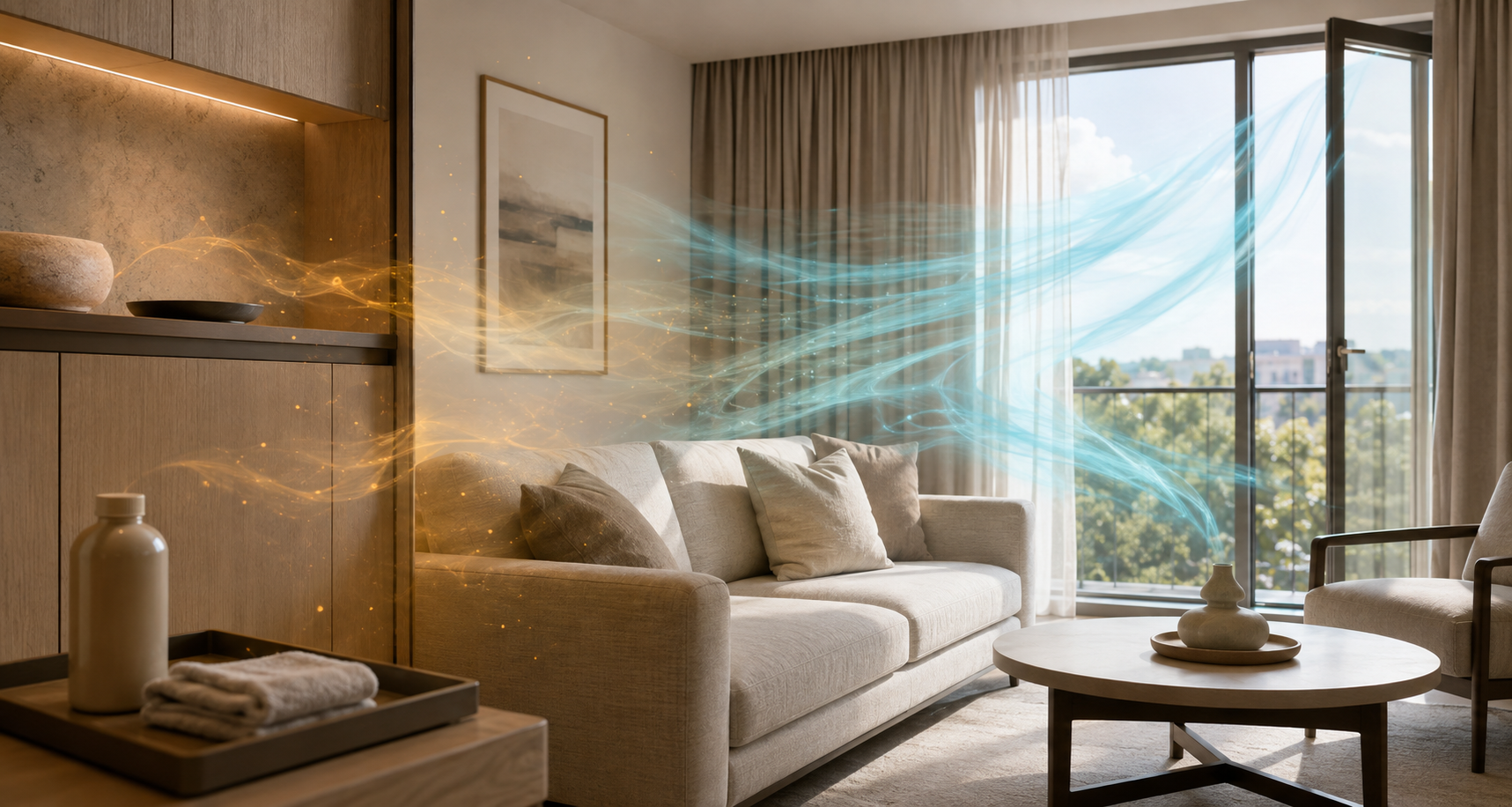
Indoor air can look clean while still feeling stale, heavy or uncomfortable. New furniture, recently installed flooring, cleaning products, cooking, pets and everyday occupancy can all introduce airborne compounds or unwanted smells.
When ventilation is limited, these emissions may remain in the room and gradually affect how the space feels. Understanding the relationship between TVOCs and odors is therefore an important part of creating a fresher and more comfortable indoor environment.
What Are TVOCs?
VOCs, or volatile organic compounds, are a large group of chemicals that can evaporate into the air at normal indoor temperatures. TVOC stands for total volatile organic compounds and represents a combined estimate of multiple VOCs detected in the air.
Common indoor sources may include:
Paints, adhesives and renovation materials
Composite-wood furniture and flooring
Cleaning products and air fresheners
Personal-care products and fragrances
Cooking, candles and tobacco smoke
Printers, craft materials and stored chemicals
Hotel amenities and frequent room turnover
A TVOC reading can help indicate changes in a room, but it does not identify every individual compound. Two spaces with similar TVOC readings may contain very different mixtures of substances.
For this reason, TVOC data is best used as a reference for observing trends, activities and possible emission sources—not as a complete chemical analysis or standalone health assessment.
Are TVOCs and Odors the Same Thing?
Not necessarily.
Some VOCs have a noticeable smell even at relatively low concentrations, while others may have little or no detectable odor. Unpleasant smells can also come from moisture, cooking residues, pets, fabrics, waste or biological sources that may not be fully represented by a TVOC reading.
A pleasant fragrance does not automatically mean the air is cleaner. Air fresheners may cover an existing odor while introducing additional airborne compounds of their own.
Smell is therefore a useful warning signal, but it should not be treated as a precise air-quality measurement. The absence of odor does not always confirm that the air is free from unwanted compounds, and a strong smell does not by itself identify the substance or its concentration.
Why Do Indoor Odors Persist?
Persistent odors are often the result of several conditions working together.
Porous materials such as carpets, curtains, bedding and upholstered furniture can absorb and slowly release odor-producing compounds. Repeated cleaning, cooking, smoking or occupancy can continuously add new emissions. Poor circulation may also create stagnant areas where odors remain concentrated.
Temperature and humidity can influence how quickly some materials release airborne compounds. In tightly enclosed or energy-efficient buildings, insufficient outdoor-air exchange may allow pollutants and odors to accumulate.
Hotels face an additional challenge because rooms experience frequent changes in guests, luggage, personal-care products, food, cleaning routines and indoor temperature. Simply adding fragrance may temporarily change the smell without addressing the underlying source.
A Layered Approach to TVOC and Odor Management
Effective indoor-air care begins with the source and then adds appropriate supporting technologies.
1. Identify and Reduce the Source
Remove unnecessary chemicals, store cleaning products securely and choose lower-emission materials when practical. Moisture problems, waste, smoke and contaminated fabrics should be addressed directly rather than covered with fragrance.
2. Improve Ventilation
Outdoor-air exchange can help dilute indoor pollutants and carry accumulated emissions out of the room. Ventilation is especially important after renovation, cleaning, cooking or the installation of new furniture.
Outdoor conditions should also be considered, particularly when pollution, humidity or extreme temperatures make unrestricted window ventilation unsuitable.
3. Maintain Comfortable Air Circulation
Air circulation helps reduce stagnant zones and moves room air toward ventilation or air-treatment systems. Gentle and evenly distributed airflow is especially important in bedrooms, studies, hotel rooms and other spaces intended for rest or extended occupancy.
4. Add Appropriate Air-Care Technology
Different technologies address different components of indoor air. Filtration is generally intended for airborne particles, while gas- and odor-management methods are designed for airborne compounds and unwanted smells.
No single device should be presented as a replacement for source control and appropriate ventilation. Instead, air-care equipment should form part of a coordinated indoor-environment strategy.
5. Monitor Changes Over Time
A TVOC sensor can help show how room conditions change after cleaning, renovation, cooking, increased occupancy or ventilation. The most useful information often comes from observing patterns rather than relying on one isolated number.
The SOMORA Air-Wellness Approach
SOMORA approaches TVOCs and persistent odors as part of a broader indoor air-wellness system—not as a problem to be hidden with stronger fragrance.
Depending on the product and application, the SOMORA approach may combine:
Whole-room air circulation
Odor and TVOC management
Engineered ion-based air care
Quiet, low-interference operation
Oxygen-enrichment technology where appropriate
These functions serve different purposes. Oxygen enrichment, for example, should not be described as a substitute for TVOC control. SOMORA integrates complementary technologies according to the room, product configuration and intended application.
The goal is to support a fresher-feeling, more comfortable indoor environment while keeping product claims connected to the relevant model, operating conditions and available test evidence.
Fresh Air Should Not Depend on Fragrance
Persistent odors often tell us that something in the indoor environment needs attention. The answer is rarely a stronger scent.
By combining source control, suitable ventilation, comfortable circulation, trend monitoring and thoughtfully selected air-care technology, homes, hotels and wellness spaces can move toward a more balanced indoor environment.
Explore SOMORA Products, Technology and Solutions to learn how different air-wellness systems can be configured for bedrooms, hotel rooms, studies and other enclosed spaces.


