
How Non-Equilibrium Ion Technology Supports Indoor Air Care
Why Ion Balance, Airflow and Ozone Control Matter More Than Ion Count Alone
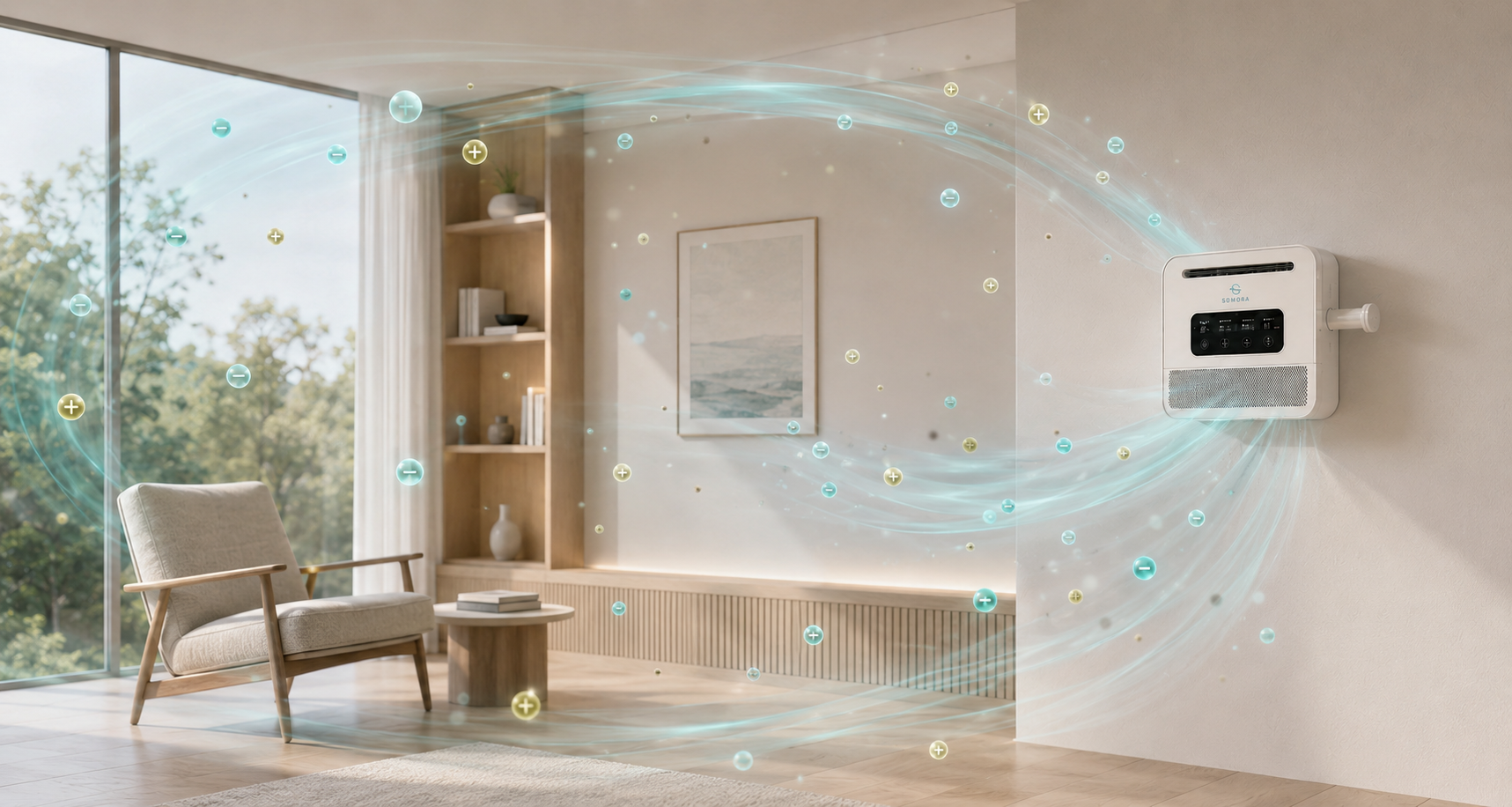
Ion technology is often explained with one simple message: more negative ions must mean better air.
In practice, effective ion-based air care depends on much more than a single ion-count figure. Ion polarity, output strategy, operating stability, airflow, room size, humidity, placement and ozone control can all influence how the technology performs in a real indoor environment.
SOMORA therefore approaches ion air care as an engineered system—not simply as a high-output negative-ion generator.
What Is Ion Air Care?
Ion-based air-care devices use an electrical field to create charged species that are released into the surrounding air. These charged species may interact with airborne particles and other components of the indoor environment.
When particles become electrically charged, they may be more likely to combine with other particles, settle onto surfaces or be attracted to a collection surface where one is provided.
Depending on the product design and verified operating conditions, ion-based technology may support:
Airborne-particle management
Odor and TVOC management
Everyday indoor air-hygiene care
Fresher-feeling occupied spaces
Ion air care is not the same as mechanical filtration. A filter captures particles as air passes through filter media, while an ion system acts through charged species distributed into the room.
The two approaches may complement each other, but they should not automatically be treated as interchangeable.
Why Ion Count Alone Is Not Enough
SOMORA's technology is designed around a positive-to-negative oxygen-ion output ratio of 1:3. While this design principle is publicly disclosed, the specific ionization structure, control methods and system engineering remain proprietary.
Some ion products are promoted primarily through a very large negative-ion count measured close to the emitter. That number does not necessarily show how much active ion output reaches the wider occupied space.
Ion performance may be affected by:
Distance from the emitter
Airflow and room circulation
Temperature and humidity
Nearby walls, furniture and fabrics
Room volume and layout
Ion lifetime and output stability
Product placement and operating mode
A strong reading close to the emission point may fall significantly as distance increases. Without suitable air movement, much of the output may remain concentrated near the device instead of being distributed throughout the room.
For this reason, SOMORA focuses on the interaction between ion generation and air circulation rather than relying on a single maximum ion-count claim.
What Does “Non-Equilibrium” Mean?
SOMORA technology is designed around the controlled coexistence of positive and negative oxygen-containing charged species.
“Non-equilibrium” means that the two polarities are not simply released as an identical 1:1 output. Their operating relationship is deliberately engineered according to the product design, intended application and air-distribution strategy.
This is not the same as releasing as many negative ions as possible, nor is it a basic symmetrical bipolar-ion system.
The design considers factors such as:
Positive and negative output characteristics
Different ion lifetimes and movement patterns
Interaction with airborne targets
Release timing and operating stability
Distribution through the occupied space
The precise output relationship and internal control method form part of the product’s proprietary engineering and should not be reduced to a publicly disclosed ratio.
The important point for users is that ion type, stability and distribution matter—not only the largest number shown on a specification sheet.
Air Circulation Is Part of the Technology
Ions cannot support whole-room air care if they remain close to the emitter.
SOMORA products therefore combine ion generation with active airflow and designed air channels. Depending on the model, room air is drawn into the lower section of the device and redistributed through an upper outlet, helping the ion output move beyond the immediate area surrounding the machine.
This active circulation supports:
More even distribution through the room
Reduced stagnant-air zones
Continued processing of recirculated room air
More consistent operation in bedrooms, hotel rooms and wellness spaces
The appropriate airflow depends on the room volume, furniture layout, installation position and intended use. Performance should always be matched to the specific model and operating environment.
Supporting Odor, TVOC and Air-Hygiene Management
Ion-based air care should not be presented as a universal solution for every indoor pollutant.
Persistent odors and TVOCs may originate from furniture, renovation materials, cleaning products, cooking, smoke, pets, moisture or repeated occupancy. Source control and suitable ventilation remain essential.
Within a layered air-wellness strategy, engineered ion technology may provide additional support for odor management, TVOC-related air care and everyday air hygiene.
Any performance claim must remain connected to:
The specific SOMORA model tested
The target pollutant or test organism
Room volume and environmental conditions
Operating level and airflow
Test duration and measurement distance
The laboratory method and report
Results from one model or test environment should not automatically be transferred to every product or room.
Why Low-Ozone Engineering Matters
Some electronic air cleaners and ion-generating devices can produce ozone as an unintended by-product of electrical discharge.
Responsible ion air care should therefore focus on controlling ozone emissions—not using ozone as the main cleaning mechanism.
SOMORA’s preferred wording is:
“Low ozone emission tested under stated conditions.”
This is more accurate than making an absolute “ozone-free” claim unless zero ozone has been verified for the specific product through an appropriate third-party test.
Low-ozone engineering may involve the design of the emitter, electrical control, operating voltage, output stability, airflow and safety protection. Ozone testing should always identify the model, room conditions, operating time, distance and measurement method.
Filter-Free Does Not Mean Maintenance-Free
Many SOMORA ion-based configurations operate without routine replacement filters, helping reduce consumable use and recurring filter costs.
However, “no routine filter replacement” should not be confused with “no maintenance.”
Charged particles may settle on nearby surfaces, and air inlets, outlets and emitter components may require periodic cleaning according to the product instructions. Rooms should also continue to receive normal surface cleaning, ventilation and source management.
Where a model includes mechanical filtration, its filter requirements should be stated separately.
Ion Air Care as Part of Air Wellness
SOMORA does not position ion technology as medical treatment or as a replacement for ventilation, cleaning, filtration or professional environmental assessment.
Instead, non-equilibrium ion technology forms one part of a broader air-wellness approach that may combine:
Engineered positive and negative ion output
Active whole-room air circulation
Odor and TVOC management
Quiet, low-energy operation
Low-ozone design and verification
Oxygen-enrichment technology where appropriate
Each function has a different role. Together, they can support a fresher-feeling and more comfortable indoor environment when the product is correctly selected, positioned and operated.
The future of ion air care is not simply about generating more ions. It is about controlling what is generated, how it moves through the room and how responsibly the system performs over time.
Explore SOMORA Products, Technology and Solutions to learn how engineered ion air care can be configured for bedrooms, hotel rooms, studies, vehicles and other occupied spaces.


